

Pool Fence Requirements on Long Island: The Rules Every Pool Owner Must Follow
October 7, 2026
•
Written By
Residential Fences Corp
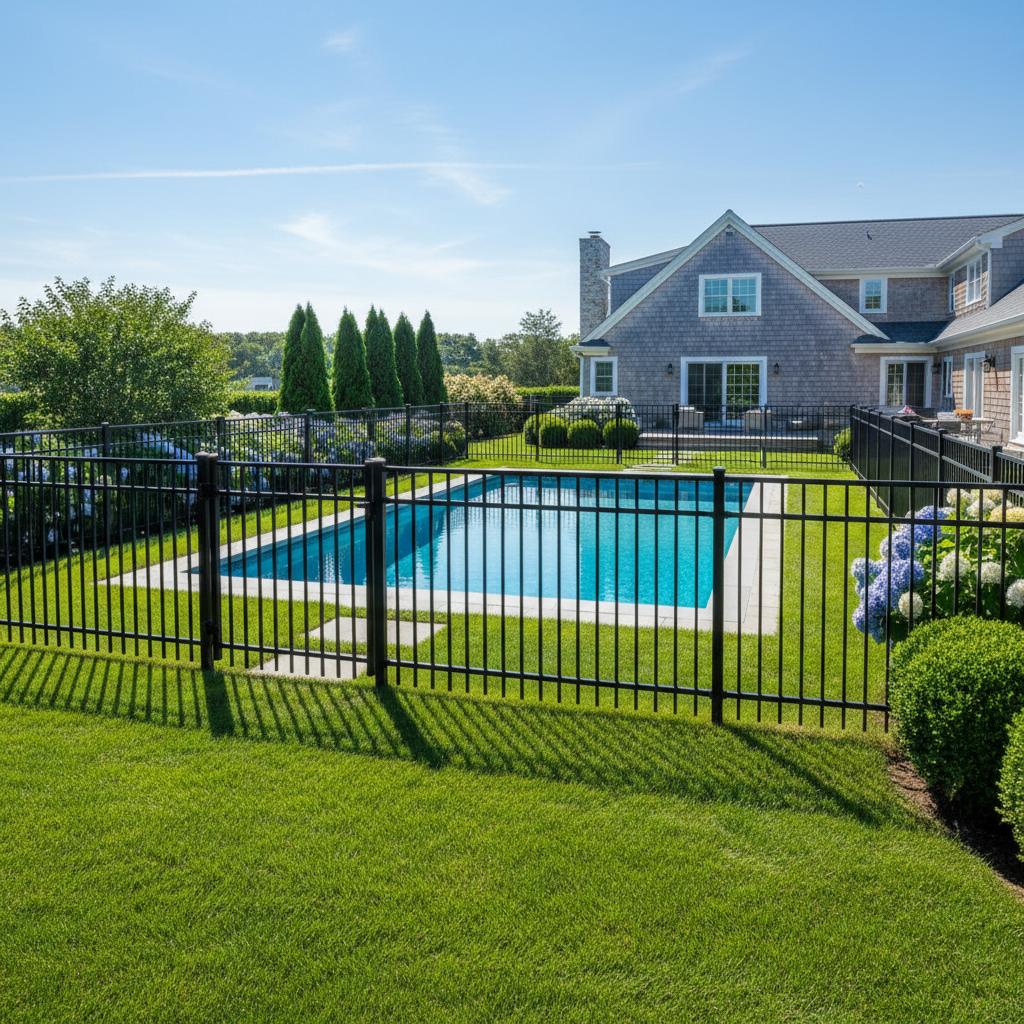
If you own a residential pool on Long Island, New York State requires it to be surrounded by a barrier at least 48 inches (4 feet) high, with self-closing and self-latching gates that open away from the pool. That barrier is mandatory for any pool capable of holding more than 24 inches of water, whether it's in-ground, on-ground, or above-ground.
Beyond that statewide baseline, your specific town in Suffolk or Nassau County adds its own permitting steps, and a few towns set the bar even higher. This guide walks through exactly what applies, so you know what a compliant pool fence looks like before you build one, replace one, or get cited for one. Pool enclosures are one of the most common projects we handle across our residential fencing service area.
Key Takeaways
Here's what matters most before you build, replace, or inspect a pool barrier on Long Island:
- New York State requires a barrier at least 48 inches high around any pool holding more than 24 inches of water, with no more than a 2-inch gap at the bottom and openings too small to pass a 4-inch sphere.
- Every gate must be self-closing and self-latching, open outward away from the pool, and have its latch at least 40 inches above the ground.
- Suffolk County reviews pool barriers through its Health Services permit process, and a permanent fence must replace the temporary construction barrier within 90 days.
- Some Nassau County towns are stricter than the state: the Town of Hempstead, for example, requires a 60-inch (5-foot) enclosure instead of 48 inches.
What Does New York State Require for a Pool Fence?
The foundation for every pool fence on Long Island is the statewide barrier standard in the Residential Code of New York State. It applies uniformly in both Suffolk and Nassau County, and towns build their local rules on top of it rather than replacing it.
According to the New York State Division of Building Standards and Codes pool barrier summary, the core residential requirements are:
- Height: the top of the barrier must be at least 48 inches above grade, measured on the side facing away from the pool.
- Bottom clearance: the gap between the ground and the bottom of the barrier cannot exceed 2 inches.
- Openings: gaps in the fence cannot allow a 4-inch sphere to pass through, which rules out widely spaced pickets or oversized decorative gaps.
- Gates: every gate must be self-closing and self-latching, open outward away from the pool, and keep the latch release at least 40 inches above the ground so a small child cannot reach it.
These rules exist for one reason, which is drowning prevention, and code officials enforce them closely at inspection. A fence that looks finished but has a gate that does not swing shut and latch on its own will not pass.
How Do Suffolk County's Pool Rules Work?
In Suffolk County, a residential pool is a permitted project from the start, not just a fencing decision made at the end. The county's Department of Health Services reviews pool and bathing permits, and your plans have to show where the barrier goes, where the gates sit, and what materials you're using.
One detail that surprises a lot of homeowners: the county's pool and bathing permit process expects a temporary 48-inch barrier around the pool during construction, and that temporary barrier has to be replaced with a permanent, code-compliant fence within 90 days of the pool being built. You cannot leave a job "mostly done" with construction fencing indefinitely.
Your town then layers its own submittal on top of the county process. In the Town of Huntington, for example, a pool permit requires plot plans showing the required enclosure height and location, the pool's size and shape, and every setback distance from the pool to your property lines. Neighboring Suffolk towns such as Smithtown run a similar plan-and-inspection process. The practical takeaway is to confirm your own town's specific submittal before you order materials, because the county permit and the town permit are two separate steps.
What's Different in Nassau County?
Nassau County pools follow the same statewide 48-inch barrier baseline, and the county enforces those rules through local building departments. Where Nassau homeowners get caught off guard is that several towns set requirements stricter than the state minimum.
The clearest example is the Town of Hempstead, which requires a pool enclosure of at least 60 inches (5 feet) rather than the state's 48 inches, and specifies non-climbable fence construction with any horizontal rails facing the pool side. A fence that satisfies the state code at 48 inches would fail inspection in Hempstead. If you live anywhere in Nassau County, treat the 48-inch state number as a floor, not a target, and verify your town's exact height rule before committing to a design.
Do Above-Ground Pools Need a Fence Too?
Yes. The 24-inch water-depth trigger applies to above-ground and on-ground pools exactly the same way it applies to in-ground pools, so a typical above-ground pool on Long Island still needs a compliant barrier.
New York's code does give above-ground pools one option in-ground pools don't have: if the pool's own wall is at least 48 inches high, that wall can serve as the barrier. The catch is the access point. Any ladder or steps must be removable and stored away when the pool isn't in use, capable of being locked, or enclosed by a code-compliant gate with the same self-closing and self-latching hardware required everywhere else. A permanent set of stairs with no gate turns an otherwise-compliant above-ground pool into a code violation.
Why Ornamental Aluminum Is the Standard Pool-Code Fence on Long Island
Once you line up all of these requirements, one fence style meets them more cleanly than any other, which is why ornamental aluminum has become the default pool barrier across Nassau and Suffolk County. Its narrow, evenly spaced pickets are engineered to defeat the 4-inch-sphere rule, it comes in heights that clear both the 48-inch state minimum and stricter town rules like Hempstead's 60 inches, and it pairs with self-closing, self-latching pool-code gate hardware right out of the box. We build it as part of our core residential fence installation service, sized to the exact code your town enforces.
Aluminum also holds up to Long Island's coastal air far better than steel, which matters for pools near the water in communities like Cold Spring Harbor on the North Shore or the estate properties of East Hampton, where salt spray would corrode a lesser material.
Because it's largely see-through, ornamental aluminum encloses a pool for safety without walling off the view the way a solid panel does. When you want full privacy in another part of the yard, a different material handles that job better, which is where our vinyl fence installation options come in.
What Happens If Your Pool Fence Doesn't Meet Code?
A non-compliant barrier is not a paperwork problem you can settle later. Your pool cannot pass its final inspection, which means it cannot be legally filled and used, and an existing fence found out of compliance can trigger a stop-use order. Beyond the code enforcement, an unenclosed or improperly gated pool is a serious liability exposure if a child or neighbor gains access. Getting the barrier right the first time is far cheaper than tearing out and redoing a fence that failed inspection.
Frequently Asked Questions About Long Island Pool Fence Requirements
These are the questions Nassau and Suffolk County pool owners ask us most often about staying compliant.
How tall does a pool fence have to be on Long Island?
At least 48 inches (4 feet) under New York State code, measured from the ground on the outside of the enclosure. Some towns require more: the Town of Hempstead in Nassau County requires a 60-inch (5-foot) enclosure. Always confirm your specific town's height rule before you build.
How large can the gaps in a pool fence be?
The space between the ground and the bottom of the barrier cannot exceed 2 inches, and openings in the fence itself cannot be large enough to pass a 4-inch sphere. That spacing standard is why closely spaced ornamental aluminum pickets are the go-to pool barrier, and why a widely spaced picket or ranch-style fence usually won't qualify.
What are the gate requirements for a pool fence in New York?
Pool gates must be self-closing and self-latching, must open outward away from the pool, and must have the latch release positioned at least 40 inches above the ground. The gate has to shut and latch on its own every time, so a gate propped open or one that needs to be pulled closed by hand does not meet code.
Does an above-ground pool need a fence on Long Island?
Yes, if it holds more than 24 inches of water. If the pool wall is at least 48 inches high it can act as the barrier, but the ladder or steps must be removable, lockable, or protected by a self-closing, self-latching gate so the pool cannot be accessed when it's unattended.
Do I need a permit for a pool fence in Suffolk County?
Pool barriers are reviewed as part of the Suffolk County Health Services pool permit, and your town also runs its own permit and inspection. A temporary barrier is allowed during construction, but a permanent, code-compliant fence must be in place within 90 days. Check both the county and your town's requirements before scheduling installation.
Get a Pool-Code-Compliant Fence Estimate
Residential Fences Corp has installed fencing across Nassau and Suffolk County since 1969, and we build pool enclosures to the exact code that applies to your town, gate hardware and all. Request your free estimate online and we'll confirm the right height, spacing, and gates for your yard, with a real number and timeline before any work begins.
Recent Articles
Residential Fencing
Pool Fence Requirements on Long Island: The Rules Every Pool Owner Must Follow
New York State requires every residential pool to be enclosed by a barrier at least 48 inches high with self-closing, self-latching gates. Here's exactly what Suffolk and Nassau County homeowners need to know about pool fence code, permits, and the fence that meets it.
October 7, 2026
Residential Fencing
How Much Does a Vinyl Fence Cost on Long Island?
Vinyl fence installation on Long Island runs $25 to $45 per linear foot. See what really affects your total cost, including town permits, HOA rules, and timing.
September 9, 2026